
 en
en de
de es
esApplication of FRP and Dual Laminate Materials in the Pulp and Paper Industry
The pulp and paper industry operates under a combination of high temperatures, mechanical stress, and corrosive chemical environments such as caustic soda, sulfur compounds, chlorine dioxide, chlorides, and hypochlorite solutions. Traditional materials — including carbon steel, rubber-lined steel, and stainless alloys — show significant degradation under these conditions, resulting in high maintenance costs and frequent downtime. Fiber Reinforced Plastics (FRP) and dual laminate systems (a thermoplastic or fluoropolymer liner with a structural FRP shell) have emerged as proven and durable alternatives for process and storage equipment. This paper reviews their material properties, application areas, corrosion resistance, design principles, safety aspects, and long-term economic and environmental benefits, supported by recent technical literature and field data.

Introduction
The modern pulp and paper process includes wood pretreatment, cooking, bleaching, oxygen delignification, chemical recovery, and wastewater treatment. These stages involve chemicals that are highly corrosive to metals — such as sodium hydroxide, black and green liquor, sulfur dioxide, chlorine dioxide, sodium hypochlorite, and peroxides.
Traditional materials like rubber-lined steel or high-alloy stainless steels often struggle to balance corrosion resistance, mechanical strength, and cost-effectiveness. FRP and dual laminate materials provide a strong alternative, offering excellent corrosion resistance, lower weight, and long-term performance — especially in chemical storage, scrubbers, and ducting applications [1][2].
Material Concepts
Fiber Reinforced Plastics (FRP)
FRP consists of a thermoset resin matrix (typically vinyl ester or epoxy) reinforced with glass fibers. The laminate structure allows the chemical barrier layer and the structural layer to be optimized independently.
Key characteristics:
-
Excellent resistance to chlorides, caustic solutions, and hypochlorite environments.
-
High strength-to-weight ratio, enabling large on-site fabricated components.
-
Design flexibility for tanks, ducts, and scrubbers of virtually any shape.
When properly designed and fabricated, FRP structures can perform reliably for decades, even in aggressive bleaching plant environments [1][3].
Dual Laminate Systems
Dual laminate constructions combine:
-
A thermoplastic or fluoropolymer liner (e.g., PP, PVC, PVDF, ECTFE, FEP, PFA) to provide a chemically inert barrier.
-
A structural FRP shell for mechanical integrity and load-bearing capacity.
This configuration is especially suitable in highly oxidizing or permeation-sensitive media, where FRP alone may not provide sufficient long-term resistance. Dual laminates are therefore widely used in bleach plant chemical handling and chlorine dioxide storage systems [2][4][5].
Corrosive Environments in the Pulp and Paper Industry
Critical process media include chlorine dioxide (ClO₂), sodium hypochlorite, caustic soda, tall oil derivatives, black and green liquor, sulfuric acid, and various condensates containing H₂S and CO₂.
In these environments, FRP and dual laminate systems have demonstrated superior performance for:
-
Chlorine dioxide and sodium hypochlorite storage tanks
-
Bleach and effluent process piping
-
Gas scrubbers and ducts for SO₂ and Cl₂ treatment
-
Caustic and acidic liquor handling lines [1][2][3]
Performance and Service Life
Field Experience
Multiple long-term field studies report FRP and dual laminate equipment remaining in service for over 20–30 years in bleach plant environments [3][6]. UTComp and Thorpe Industrial, among others, have documented minimal degradation of corrosion barriers when materials are properly selected and fabricated [5][6].
A notable case study describes two FRP chlorine dioxide tanks operating for over 30 years in continuous service, showing only localized wear in the inner corrosion layer [6]. Failures that do occur are generally attributed to design or fabrication deficiencies rather than inherent material limitations [1][3][4].
Inspection and NDT
Modern non-destructive testing (NDT) techniques — such as ultrasound, laser shearography, and advanced thermography — have improved the reliability of in-service FRP inspection. These methods allow early detection of delamination, blistering, or corrosion layer thinning [5].
Application Areas
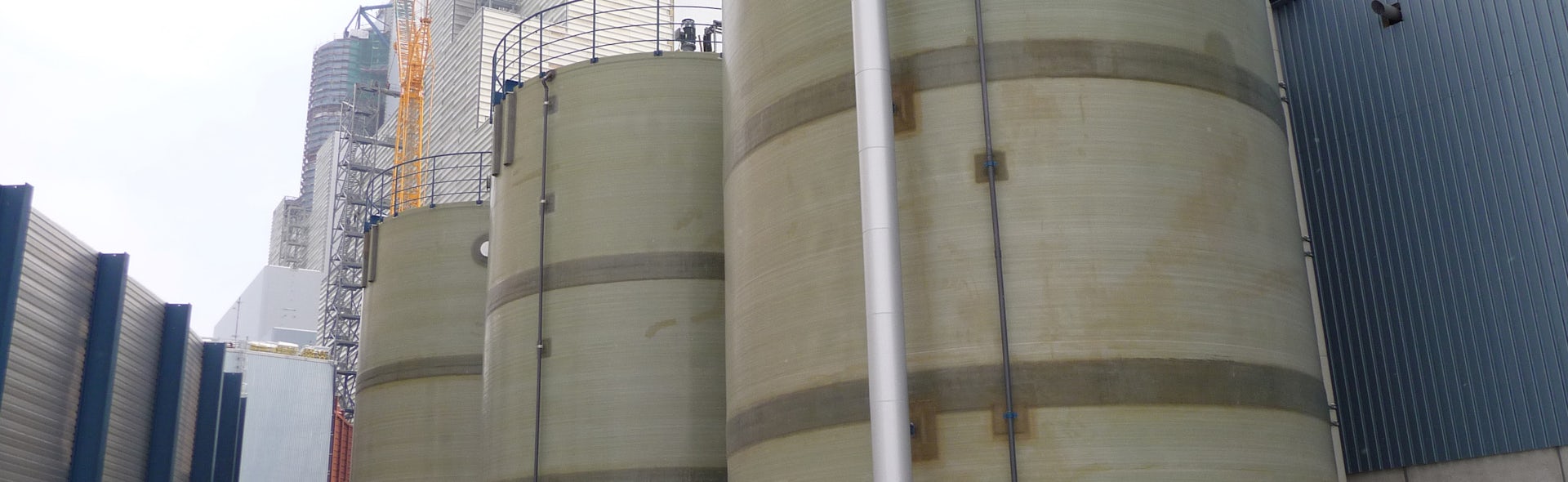
Storage and Process Tanks
FRP and dual laminate tanks are commonly used for:
-
Chlorine dioxide, sodium hypochlorite, caustic soda, and tall oil storage
-
Chemical mixing vessels
-
Wastewater and condensate treatment tanks
Benefits include corrosion resistance without expensive alloys, large diameters (7–20 m and beyond) achievable via on-site fabrication, and lower foundation loads due to reduced weight [3][4].
Piping Systems
Dual laminate piping systems (e.g., PVDF/FRP, ECTFE/FRP) provide safe transport for strongly oxidizing, acidic, or caustic media, outperforming rubber-lined steel and certain high-alloy metals in chemical bleaching and recovery circuits [2][4][7].
Gas Cleaning and Emission Control
FRP is a standard material for absorbers, scrubbers, and ducting systems handling SO₂, HCl, and Cl₂ gases. Its excellent corrosion resistance combined with lightweight construction makes it particularly suitable for large-scale gas handling installations [1][3][6].
Design and Safety Considerations
Proper design and quality assurance are essential for reliable FRP and dual laminate equipment. Key aspects include:
-
Design standards: ASME RTP-1, EN 13121, and NACE guidelines.
-
Material compatibility: resin and liner selection based on medium, temperature, oxidation potential, and permeation resistance [1][2].
-
Mechanical design: low allowable stresses, creep considerations, and adequate support and anchoring.
-
Lamination and corrosion barrier: correct glass/resin ratio, curing control, and thickness verification.
-
Dual laminate bonding: secure adhesion between liner and FRP, particularly around nozzles and flanges.
-
Inspection & testing: visual inspection, spark testing, ultrasonic NDT, and regular condition monitoring [5][6].
Failure analysis consistently shows that design or fabrication errors (e.g. under-curing, poor detailing, or wrong resin choice) — rather than material limitations — are the leading causes of premature failures [1][3][5].
Sustainability and Economic Analysis
Life Cycle Cost (LCC)
Although initial investment for FRP or dual laminate systems can be comparable or slightly higher than for rubber-lined steel, their total cost of ownership is substantially lower due to:
-
Reduced maintenance and inspection frequency
-
Extended service life (20–30+ years)
-
Lightweight construction → lower foundation and handling costs
Several life cycle assessments confirm that FRP systems provide superior cost efficiency and reliability in corrosive service [1][4].
Environmental Impact
Sustainability benefits include:
-
Fewer leaks and emissions thanks to higher chemical resistance and integrity
-
Reduced transport and lifting energy
-
Extended lifetime reduces overall material consumption
Recent R&D efforts are focused on bio-based and recyclable resins, which will further enhance the environmental performance of FRP in future applications [1].
Discussion
Scientific and industrial data clearly demonstrate that FRP and dual laminate materials are mature, safe, and economically viable solutions for corrosive environments in the pulp and paper sector.
They enable process reliability while reducing maintenance, emissions, and lifecycle costs.
Future development priorities include:
-
Long-term monitoring of permeation and stress corrosion in mixed oxidizing media
-
Improved NDT and in-service health monitoring methods
-
Enhanced adhesion and mechanical properties for dual laminate interfaces
-
Increased sustainability through recyclable and low-carbon resin systems
Conclusion
FRP and dual laminate systems have evolved from alternative materials into core technologies for corrosive service in the pulp and paper industry — particularly in bleaching, chemical handling, gas cleaning, and effluent treatment.
Their combination of excellent corrosion resistance, design flexibility, lightweight construction, and proven long-term reliability makes them indispensable for modern, sustainable industrial operations.
Where engineering design, material selection, and fabrication quality are ensured, service lives of several decades are achievable with minimal maintenance — representing a clear technical and economic advantage.
References
[1] FRP Material Selection Guide – Aqua & Energy Expo (2022).
[2] Stainless Steels and Specialty Alloys for Pulp, Paper and Biomass – The Nickel Institute (2022).
[3] FRP & Dual Laminate Tanks – RPS Composites (2023).
[4] Thorpe Plant Services – “FRP and Dual Laminate Specialists: Tank Corrosion Control” (2016).
[5] Evident Scientific – “Inspecting FRP Composites: Innovative Ultrasonic NDT Techniques” (2022).
[6] UTComp Field Study – “Chlorine Dioxide FRP Tanks after 30 Years of Continuous Service” (2023).
[7] Andronaco Industries – “Dual Laminate Piping Systems for Corrosive Media” (2022).